
Lately, semiconductor stocks have been hot. That caught my attention—I spent years in that industry helping build wafer fabrication facilities in Austin, Texas, and traveling to semiconductor manufacturing facilities and equipment companies around the world, among other things.
But I also know how difficult it is to consistently succeed investing in narrow segments or individual stocks.
It’s interesting to watch parts of the market get “hot” in the short term. It’s even tempting to jump in.
You might get lucky.
But is luck a good investment strategy?
If you follow our approach to Evidence-Based Investing, you know we focus on long-term, statistically significant market behavior—not short-term trends.
We’re numbers people—not hype people. Scientists, not promoters.
One of those long-term statistically verified behaviors is that small company stocks have outperformed large company stocks over time. Another is that value stocks have outperformed growth stocks.
A quick definition:
Value stocks: Companies trading at lower prices relative to their book value.
Growth stocks: Companies trading at higher relative valuations relative to their book value.
When you combine these two factors—small and value—you get small value stocks, which historically have captured both return premiums.
So… Are Small Value Stocks “In Favor” Right Now?
That’s the wrong question.
Because any segment of the market can go in—or out—of favor for years. And when it’s out of favor, it can feel like it will never come back. Then suddenly… it does.
Exhibit A: How Fast Things Can Change
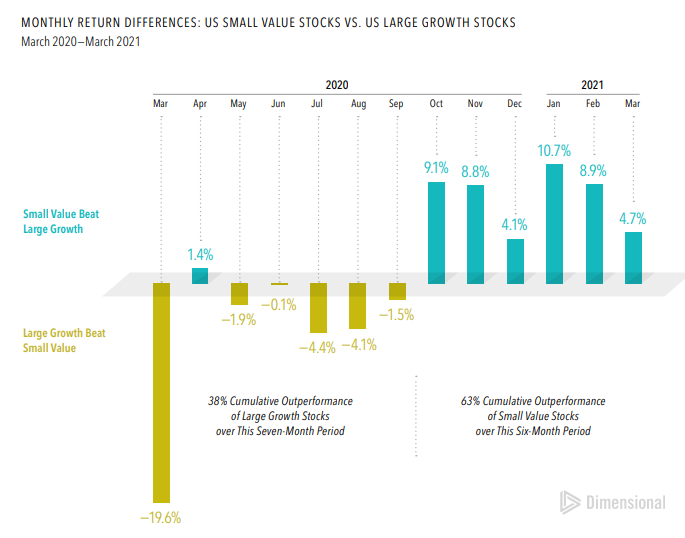
As shown in the first chart (March 2020–March 2021), large growth stocks dominated early in the pandemic—beating small value by 38% over a seven-month stretch.
Then the script flipped. In just the next six months, small value stocks outperformed by 63%. No warning. No signal. No time to reposition.
If you weren’t already invested, you likely missed it.
Exhibit B: What Happens Over the Long Term
Now zoom out.
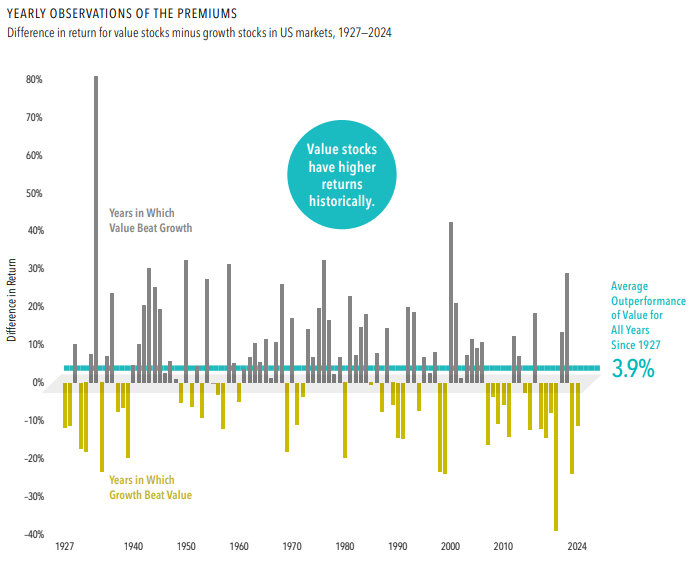
Over nearly a century of data, value stocks have outperformed growth stocks by an average of about 3.9% per year.
But that outperformance doesn’t show up smoothly. Some years, growth wins—sometimes by a lot. Other years, value dominates.
The key takeaway:
The premium is real… but like any particular market segment, it’s inconsistent.
What We Actually Do
We don’t try to predict when small value will outperform.
We don’t chase what’s “hot.”
And we don’t abandon parts of the market when they fall out of favor.
Instead, we tilt portfolios toward small and value stocks—owning them in higher proportions than the overall market—while still maintaining broad diversification.
That positioning allows us to participate in long-term expected returns…without having to time when they show up.
Final Thought
Small value stocks may or may not be “in favor” right now.
But history suggests that’s not what matters.
What matters is being there when the premium shows up—because when it does, it often shows up fast and decisively.
And by then, it’s too late to react.